Skip to content
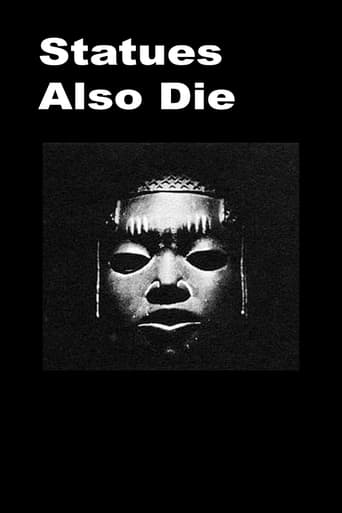
Statues Also Die poster
Recommendations based on

Statues Also Die

6.9 1953 Movie Documentary

Commissioned by the journal Présence Africaine, this short documentary examines how African art is devalued and alienated through colonial and museum contexts. Beginning with the question of why African works are confined to ethnographic displays while Greek or Egyptian art is celebrated, the film became a landmark of anti-colonial cinema and was banned in France for eight years.

Same cast & genre

17 Shares actors and at least one genre with this title
La TV des 70's : Quand Giscard était président poster
FILM

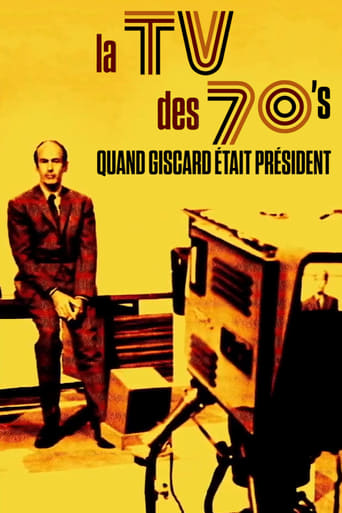
In May 1974, Valéry Giscard d'Estaing became President of the Republic and wanted to bring about a new era of modernity. One of his first decisions was to break up the ORTF with the creation of three new television channels: TF1, Antenne 2 and FR3. Three new public channels but autonomous and competing. It is a race for the audience which is engaged then, and from now on the channels will make the war! This competition will give birth to a real golden age for television programs, with variety shows in the forefront. The stars of the song are going to invade the living rooms of the French for their biggest pleasure. This unedited documentary tells the story of the metamorphosis of this television of the early 1970s, between freedom of tone, scandals, political intrigues and programs that have become mythical.

La TV des 70's : Quand Giscard était président

2022 History
François Mitterrand, à bout portant : 1993-1996 poster
FILM

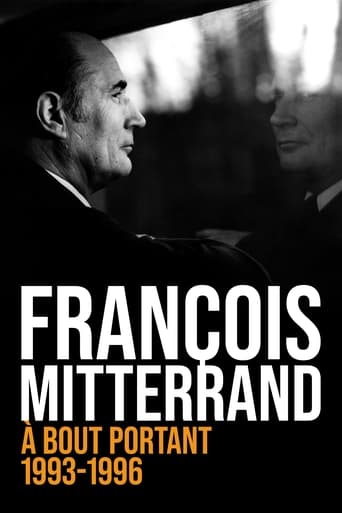
"What could be more unsettling than a man close to death whose profound arrogance drives him relentlessly to hang onto both his power and his writing, to the bitter end?" In the twilight of his second seven-year term, François Mitterrand was alone. Ravaged by illness and abandoned by a large majority of the Socialist Party, who would not forgive him for the disastrous outcome of the March 1993 elections, the Head of State was preparing to tackle a second round of cohabitation with the right wing. However a series of unexpected tragedies and revelations would arise, casting a shadow over the end of his reign…

François Mitterrand, à bout portant : 1993-1996

2011 Documentary
Reporters poster
7.0 FILM

The co-founder of the Gamma press agency, Raymond Depardon, created this documentary of press photographers in Paris and their subjects by following the photographers around for one month, in October, 1980. In-between long hours waiting for a celebrity to emerge from a restaurant or a hotel, boredom immediately switches to fast action as the cameras click and roll when the person appears. The reaction to the gaggle of photographers is as varied as the people they often literally chase all around town. While some of the celebrities, such as Jacques Chirac who was mayor of Paris at the time, are perceived as comical caricatures, others are shown simply going about ordinary pursuits - including Catherine Deneuve, Gene Kelly, and Jean-Luc Godard.

Reporters

1981 Documentary
Gene Kelly: An American in Hollywood poster
FILM

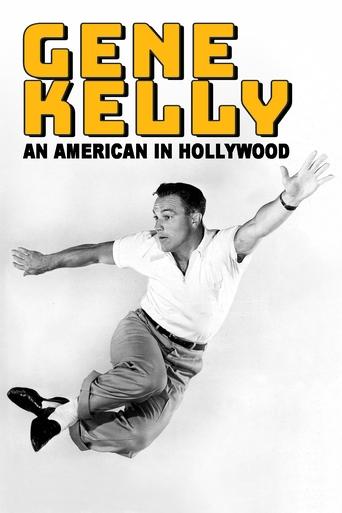
Gene Kelly is a legend of the heyday of the Hollywood musical. His name stands for masterpieces such as "Singin' in the Rain" and "An American in Paris". As a singer, dancer, actor, choreographer and director, he was a true all-round artist who revolutionized the world of dance in particular. Kelly, who loved to experiment, explored new forms of dance expression and helped a whole generation of young talents to fame. From his beginnings in cabarets and on Broadway to his recognition as a choreographer and director, the documentary shows how the good-looking star with a charming smile expanded the boundaries of dance expression: He danced in the open air in the streets of New York, with a cartoon character or his own reflection. But this dazzling entertainer image should not obscure the fact that Kelly, as a staunch supporter of the American civil rights movement, also saw dancing as a political statement.

Gene Kelly: An American in Hollywood

2025 Documentary
La Rabbia poster
7.0 FILM

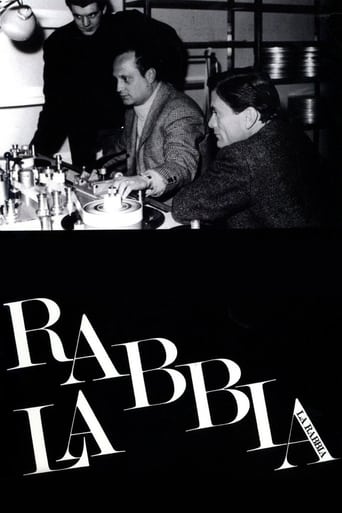
Documentary footage (from the 1950s) and accompanying commentary to attempt to answer the existential question, Why are our lives characterized by discontent, anguish, and fear? The film is in two completely separate parts, and the directors of these respective sections, left-wing Pier Paolo Pasolini and conservative Giovanni Guareschi, offer the viewer contrasting analyses of and prescriptions for modern society. Part I, by Pasolini, is a denunciation of the offenses of Western culture, particularly those against colonized Africa. It is at the same time a chronicle of the liberation and independence of the former African colonies, portraying these peoples as the new protagonists of the world stage, holding up Marxism as their "salvation", and suggesting that their "innocent ferocity" will be the new religion of the era. Guareschi's part, by contrast, constitutes a defense of Western civilization and a word of hope, couched in traditional Christian terms, for man's future.

La Rabbia

1963 Documentary

Closely Ranked

10 Ranked across franchise, crew, cast, themes, genre, era and audience scores