
Skip to content
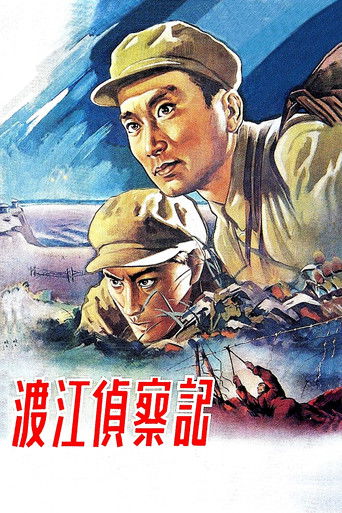
Reconnaissance Across The Yangtze poster
Recommendations based on

Reconnaissance Across The Yangtze

1954 Movie Drama War

In the spring of 1949, a war is about to happen between the Liberation Army and Kuomintang Army on the Yangtze River. The Liberation Army dispatches a reconnaissance to scout the southern parts of the River, whose work is actually full of hardships and dangers. However, with the help of the local crowd and the guerrillas, finally, the members of the reconnaissance succeed in the commission and offer valuable information to the Liberation Army, making great contributions in the war.

Same cast & genre

40 Shares actors and at least one genre with this title
The Go Masters poster
FILM

Ten years before the outbreak of the Second World War in Asia, a Japanese Go master and his Chinese rival meet in China to play a game of Go (loosely described as an Asian version of chess). It soon becomes evident that the Chinese master's son is the most talented player that the Japanese master has ever encountered, and he convinces the boy's father to let him bring the child back to Japan to train him as a professional Go player. Years pass, and as the young Chinese master grows to maturity in Japan, the Japanese invasion of China forces him to choose between his triumphant career and his loyalty to his native country. His decision is complicated by his marriage to the daughter of the Japanese master, with whom he has produced a child. His choice will profoundly alter the lives of two families. Their saga serves as a reflection of the tragic relations between their two great countries, and the possibility of reconciliation and healing.

The Go Masters

1982 Drama
Family poster
FILM

Based on the famous novel of the same name by well-known author Ba Jin, this movie traces the decline of a large, wealthy family in the early part of the twentieth century. The story focuses on three brothers and how they respond to the expectation that they will each marry women whom their grandfather has selected for them. The lure of family money on the one hand and modern individualism on the other plays out differently among the young men. Critics consider this movie an indictment against feudal ideas.

Family

1957 Drama
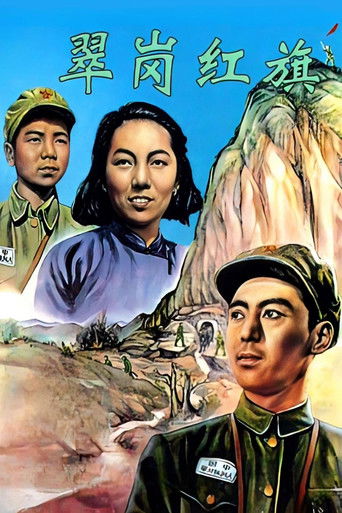
Red Flag on the Green Hill poster
FILM

1930s, Jiangxi Soviet Area. Jiang Mengzi bids farewell to his newlywed wife Xiang Wu'er and joins the main force of the Red Army on the Long March. Xiao Zhenkui, the leader of the "Communist Removal Group", took the opportunity to return to the countryside to launch a white terror. Mengzi's father, chairman of the Township Soviet, and his sister were killed at the same time. The pregnant Wu'er gave birth to a child on the way to escape. Wu'er is found out hiding and forced to work as a wet nurse. Will Mengzi return in time to save his family?

Red Flag on the Green Hill

1951 Drama
Spring is Splendid Color poster
FILM

In the late 1950s, during China’s Great Leap Forward, Shanghai housewives participated, supported by Dai Mama from the neighbourhood committee. Liu Mama opposed her daughter-in-law Wang Caifeng’s involvement, wanting her to stay home, but her son Liu Genfa supported Caifeng. Zheng Baoqing also opposed his wife Cai Guizhen joining the production group, but Cai ignored him, organised her household, and led the sewing group. Dai Mama helped persuade Zheng Baoqing to change his mind. Lu Afeng joined the sewing group out of fear they would borrow her machine but felt ashamed when they made coats for the children’s welfare home.

Spring is Splendid Color

1959 Drama
Along The Jinsha River poster
FILM

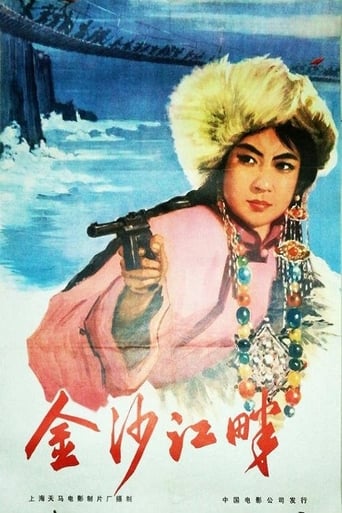
In 1936, the Long March of the Red Army passed through the Tibetan area by the Jinsha River. The Kuomintang colluded with the great local tyrant Qiu Wanli in an attempt to prevent the Red Army from crossing the river north. Qiu Wanli asks his minions to pretend to be the Red Army and rob the chieftain Sangge's only daughter Zhuma to provoke the relationship between the chieftain and the Red Army. The Red Army adhered to the party's ethnic policy, rescued Zhuma, and crossed the Jinsha River to the border of Tibetan areas. Qiu again sneaked into the Tibetan area. He said that Zhuma had been killed by the Red Army and provided ammunition and weapons for the chieftain to fight the Red Army. In order to expose the enemy's rumors, the Red Army instructor Jin Ming took a squad to escort Zhuma home.

Along The Jinsha River

1963 Drama
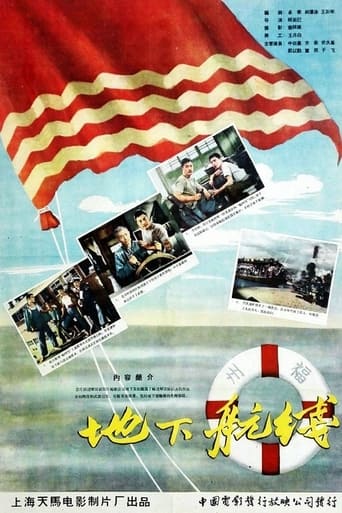
Underground Route poster
FILM

The Min River is crucial for Fujian Province’s economy. In 1947, Lin Sen Guan, a Communist Party member and driver of the “Fuzhou” steamship, smuggled weapons and radios to a guerrilla base with fellow party members. The enemy, led by transportation inspector Wang Xun, sent spy Li Boguang to monitor them. Lin Sen Guan tricked Li Boguang, but the spy later discovered the weapons. Lin Sen Guan pushed him into the water, witnessed by helmsman A Wang, who refused to reveal the truth despite enemy pressure. The underground party decided to transport remaining weapons to the guerrilla zone. The “Fuzhou” set sail, followed by enemy ships. Near Luohan Tan, a guerrilla team unloaded the weapons. The enemy opened fire, but A Wang steered the “Minh River” into an enemy vessel, causing mutual destruction. The weapons reached the guerrilla zone, and Lin Sen Guan continued their underground efforts.
Underground Route

1959 War

Closely Ranked

10 Ranked across franchise, crew, cast, themes, genre, era and audience scores
Devils on the Doorstep poster
79% match FILM

During the Japanese occupation of China, two prisoners are dumped in a peasant's home in a small town. The owner is bullied into keeping the prisoners until the next New Year, at which time they will be collected. The village leaders convene to interrogate the prisoners. The townspeople then struggle to accommodate the prisoners. One is a bellicose Japanese nationalist, the other a nervous translator. Will the townspeople manage to keep the prisoners until the New Year?

Devils on the Doorstep

★ 8.2 2001 Drama

Viewers also picked